
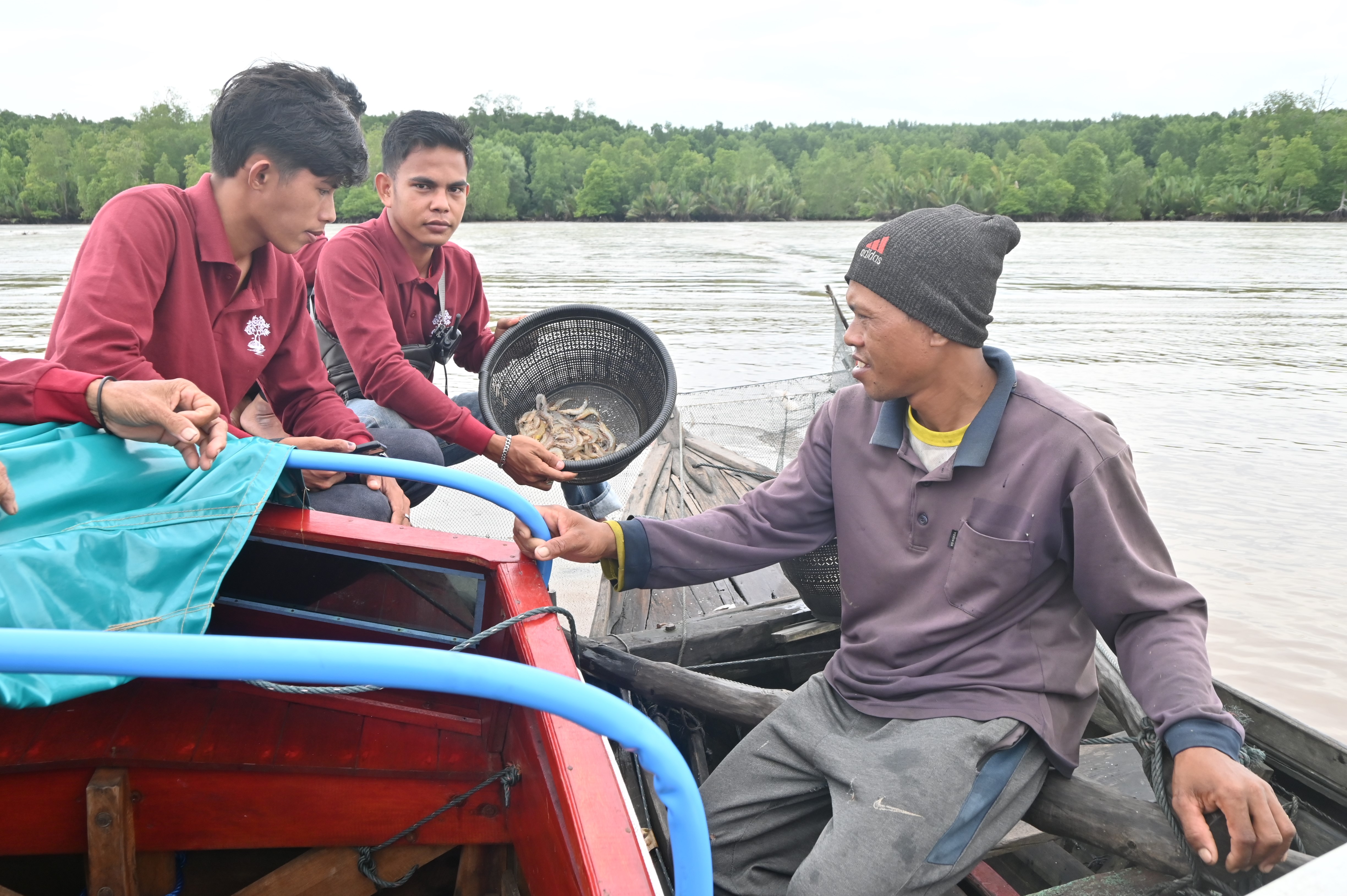
The speedboat gradually slowed down, leaving gentle ripples between the thick mangrove forests lining the waters of Igal Village in Indragiri Hilir. On the deck, Alfian quickly raised his phone, aiming the camera at a calm, rippling spot. “A dolphin, it’s a dolphin!” exclaimed the member of MMP, and the Igal Bertuah Pokmaswas spontaneously. His excitement was met with equally enthusiastic looks from his fellow crew.
Although the rare marine mammal only appeared briefly and didn’t leap high above the surface, it was caught on video for several minutes. For locals who frequently travel these waters, witnessing an Irrawaddy dolphin is a special treat a sign that life persists within the mangrove ecosystem of Indragiri Hilir Regency.
This moment happened on April 13, 2025, during a mangrove ecosystem and Marine Conservation Area (Kawasan Konservasi Daerah/KKD) monitoring activity in Indragiri Hilir. The effort was jointly carried out by the Forest Ranger Community Partners (MMP) and Community Surveillance Groups (Pokmaswas) from two neighboring villages: Igal and Pulau Cawan. Since 2022, these community based groups have been actively safeguarding mangrove ecosystems and fishery resources at the grassroots level. Their regular patrols aim to prevent and reduce the destruction of natural resources, such as mangrove logging and fish poisoning.
The presence of the Irrawaddy dolphin (Orcaella brevirostris) in Indragiri Hilir waters is more than just good fortune. It signifies that the ecosystem is still functioning despite facing increasing pressures. This dolphin, along with emperor breams (family Lethrinidae) and mantis shrimp (Oratosquilla oratoria), are now part of the KKD Indragiri Hilir’s conservation targets, as defined by the Minister of Marine Affairs and Fisheries Decree No. 107 of 2023. The Irrawaddy dolphin is classified as Endangered (IUCN Red List, 2017), while emperor bream and mantis shrimp are high-value fishery commodities targeted by fishers from Indragiri Hilir and surrounding areas like Jambi and the Riau Islands.
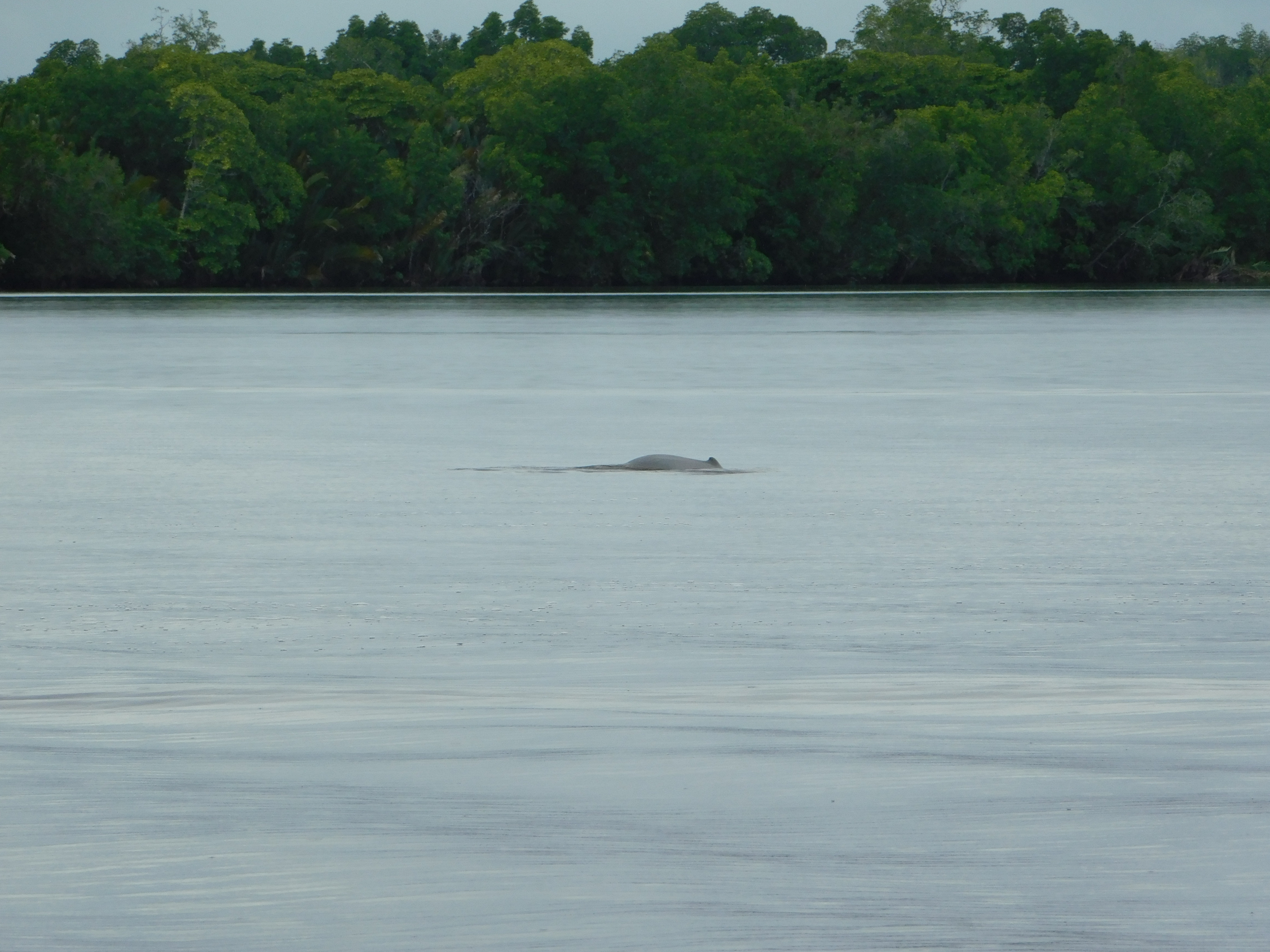 The appearance of the Irrawaddy dolphin in the mangrove ecosystem habitat – Achmad Juwardi/Blue Forests
The KKD Indragiri Hilir covers a marine area of 126,097.64 hectares, spanning the waters of 19 administrative villages, including Igal and Pulau Cawan. Establishing this zone is a strategic step toward integrated landscape-seascape management, aiming to preserve mangrove ecosystems and fishery resources that are vital to the livelihoods of coastal communities in the regency.
Strengthening the management of the KKD is encouraged through the integration of multiple stakeholders. The Riau Province Marine and Fisheries Department (DKP) has formed a dedicated Management Unit Organization (SUOP) as the main body for effective and sustainable management. Support has also come from agencies such as BPSPL Padang, the Faculty of Fisheries and Marine Science at the University of Riau, and the Blue Forests Foundation. This initiative contributes to Indonesia’s goal of conserving 30% of its marine areas by 2045.
“DKP Riau is accelerating the establishment of marine conservation areas in the province, including the KKD in Indragiri Hilir,” said Aprilla Yunita, Head of the SUOP for Riau’s marine conservation area. “We must continue collaborating with committed stakeholders. NGOs and universities are always invited to work with us on conservation efforts.”
Local communities have been quick to respond. In Igal and Pulau Cawan villages, MMP and Pokmaswas members welcomed the KKD’s designation. With three years of experience under their belts, they feel empowered and ready to take on key roles. These community based surveillance groups are well trained and experienced in monitoring mangrove ecosystems and small scale fishing grounds. Their routine monitoring is done in coordination with the area’s forest rangers (Polhut) and the Fisheries Surveillance Unit (UPT PSDKP) of Region 1. Support from village governments and NGOs continues to strengthen their work.
“In our villages (Igal and Pulau Cawan), illegal logging and fish poisoning used to be common,” recalled Ridwan Mukhtar, aka Pak Wan, the Chair of MMP and Pokmaswas Igal Bertuah. “Since we started regular patrols, violations have dropped significantly. Fish poisoning is now almost unheard of.”
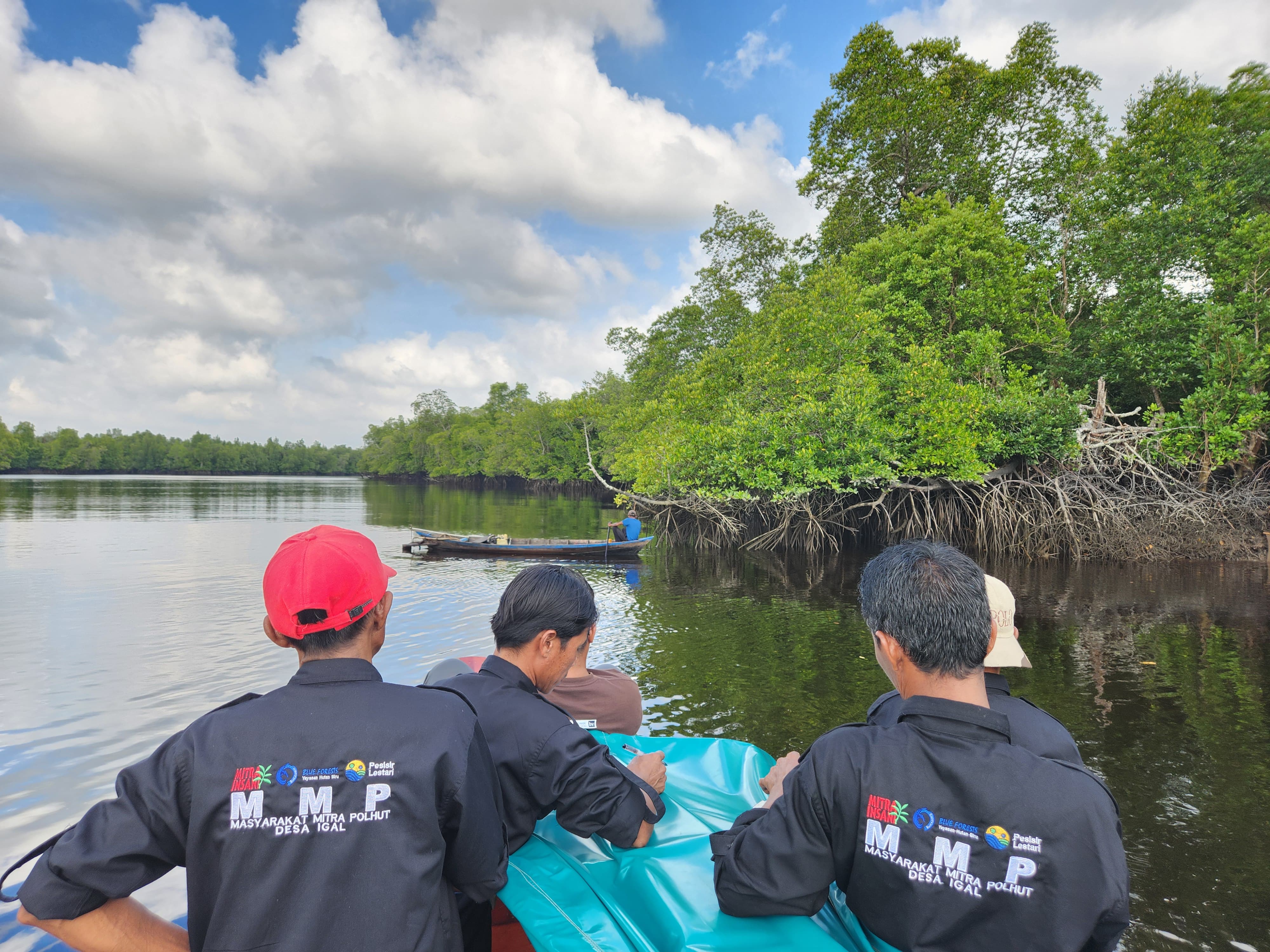 Data collection of fishing activities by MMP and Pokmaswas in Igal Village – Wahyudin/Blue Forests
The KKD designation in 2023 has given a new focus to MMP and Pokmaswas in Igal and Pulau Cawan. Members received orientation on the KKD’s conservation targets and strategies for community involvement. These efforts align with what they’ve been doing since 2022. Integrating land and sea conservation is crucial, given the shared threats such as coastal erosion, saltwater intrusion ruining coconut plantations, and mass migrations caused by submerged settlements.
“We villagers must protect the mangroves. Fishing grounds must not be poisoned. If the mangroves and fishery resources are damaged, we lose everything. Where would we live? How would we earn money?” said Dodi Subagio, Chair of MMP and Pokmaswas Tirusan Cawan, Pulau Cawan Village.
Mangrove ecosystems in Pulau Cawan are the principal fishing grounds for locals and neighboring villages. The community surveillance group there is named “Tirusan Cawan,” after the prized emperor bream fish (ikan tirusan). The swim bladders of these fish can sell for hundreds of thousands to millions of rupiah due to their use in collagen products and international demand. This popularity has led to overfishing, making their inclusion in the KKD’s conservation list a vital step not only to protect the species but also to safeguard the livelihoods of small scale fishers.
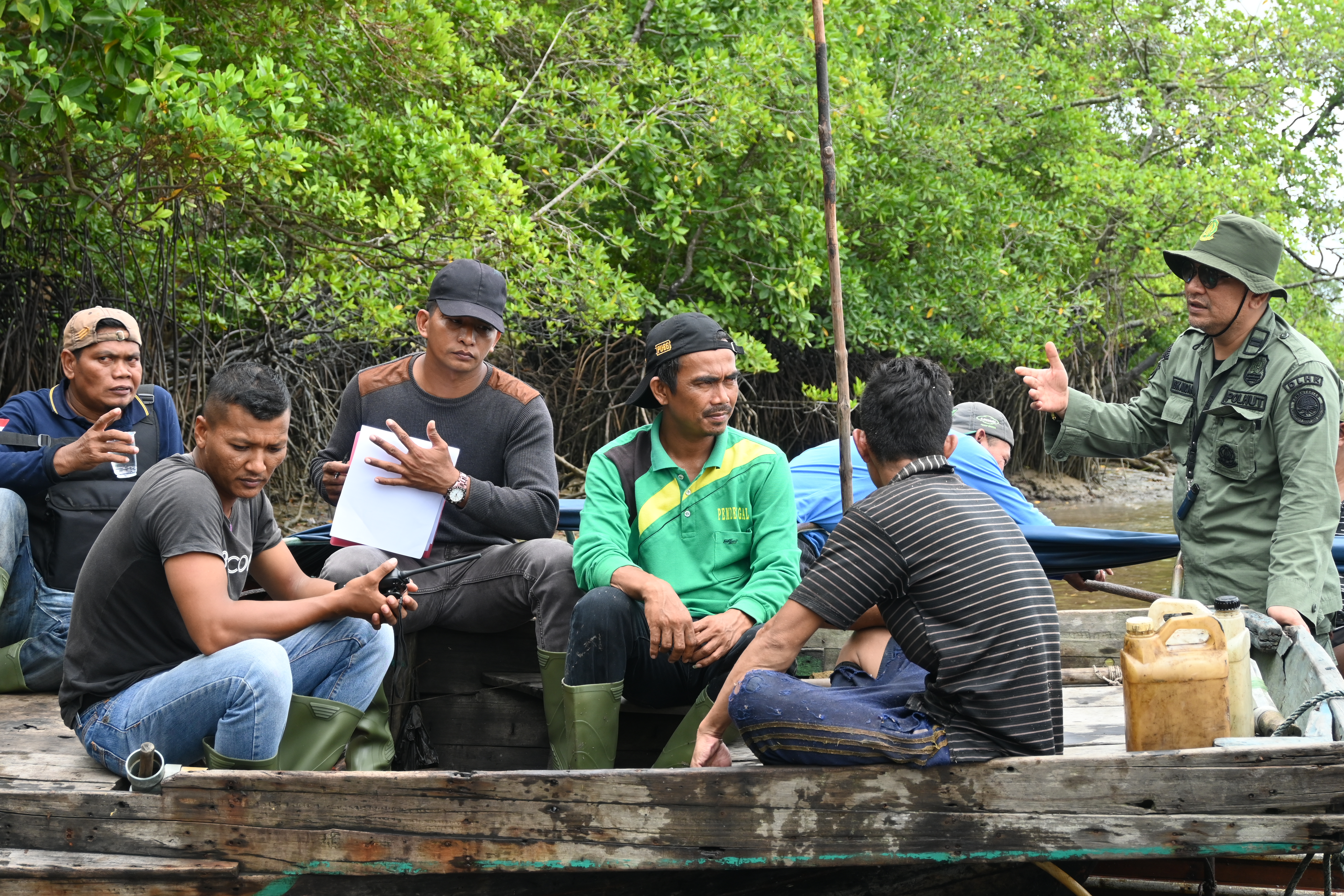 The MMP of Igal Village, together with forest rangers from KPH Mandah, halted mangrove logging activities – Wahyudin/Blue Forests
Continuing Conservation Through Community Empowerment
The stories from Igal and Pulau Cawan convey a broader message: environmental protection can emerge from community initiatives grounded in proximity to and dependence on natural resources. Since 2022, the local environmental groups have been conducting patrols, sharing information, and building inter-village collaboration based on real needs and field conditions.
Their efforts are paying off. Illegal mangrove logging is in decline. Fish poisoning has virtually ceased. There is a growing collective awareness among villagers to protect the mangroves and fishing waters on which they rely.
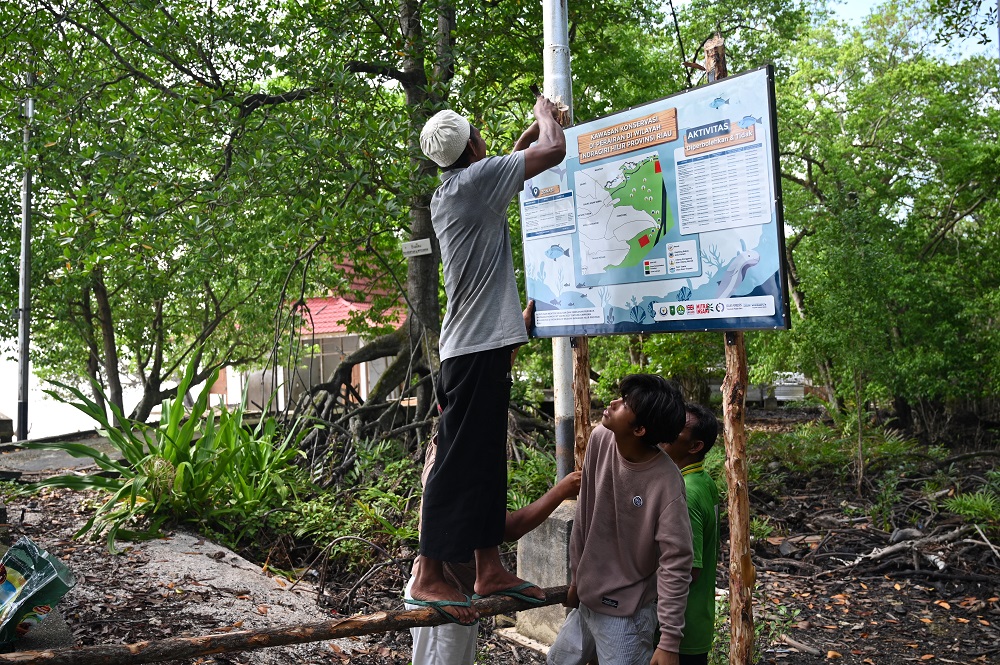
Yet their work is far from over. New challenges emerge: how to ensure the long-term sustainability of these efforts? Group independence has become a primary concern. They realize that external support may not last forever. Hence, they are beginning to plan gradually and realistically.
Strategic plans are being developed to ensure continued monitoring and conservation. Regular coordination with stakeholders, including Polhut, DKP Riau, village governments, and NGOs, is ongoing. External support is considered essential for sustaining operations and ensuring access to technical and institutional resources.
At the same time, the groups are exploring independent initiatives based on local natural potential. One strategy involves establishing sustainable, community-run businesses, such as partnering with fishers to collect seafood. Their experience in mangrove rehabilitation also opens opportunities for nursery development, supporting the widespread mangrove reforestation efforts in Indragiri Hilir. This way, conservation becomes not only an ecological responsibility but also an economic opportunity that supports group sustainability.
“If our mangroves and rivers are preserved, we villagers will be the ones who benefit,” said Dodi Subagio of Tirusan Cawan. “That’s why we must plan and work together.”
Amid the thick mangroves and calm waters of Igal and Pulau Cawan, conservation efforts persist. Once seen merely as beneficiaries, local communities now lead the way. They are not just protecting nature they are securing the future of their villages. And that hope lives on, surfacing every time a rare dolphin appears during one of their patrols—a sign that the mangrove ecosystem and fishery resources are recovering and thriving.